
Iran has submitted its latest proposal aimed at advancing negotiations to end the ongoing West Asia conflict with the US, days after the Islamic Republic submitted a fresh proposal through regional intermediaries to cease its military operations in the Strait of Hormuz, which is likely to get rejected by Washington.

Iran has blamed the US for disruptions in oil and gas shipping through the Strait of Hormuz, citing 'destabilising actions' as the cause amid the ongoing West Asia conflict and rising energy prices.

In a lengthy post on Truth Social, Trump said negotiations with Iran were 'proceeding nicely' and argued that several Muslim and Arab nations should formally recognise Israel and join the Abraham Accords once a deal is reached.

US President Donald Trump and Chinese President Xi Jinping met in Beijing to discuss a range of issues, including trade frictions and the war in Iran.

Much will depend on how the protagonists use the current interlude to work proactively for the beginning of a durable settlement or, on the contrary, prepare for a new round of escalation, points out Ambassador M K Bhadrakumar.

US President Donald Trump is set to visit China for talks with President Xi Jinping on trade, global issues, and the Gulf war. The visit aims to address trade frictions and other key issues, with high expectations for progress.

Earlier in the day, the ministry of external affairs "strongly advised" Indians to avoid travel to Iran until further notice, amid rising tensions and protests in the Islamic Republic.

Pakistan is set to host a quadrilateral summit of foreign ministers from Saudi Arabia, Egypt, and Turkiye to discuss the ongoing conflict in West Asia and explore avenues for peace negotiations.

Pakistan has announced its commitment to continue facilitating talks between the United States and Iran, urging both nations to uphold the ceasefire agreement. Deputy Prime Minister Ishaq Dar highlighted Pakistan's role in mediating recent discussions and expressed hope for durable peace and regional stability.

Iran has asserted that maritime movement through the Strait of Hormuz will be strictly controlled by Tehran, stating that passage will be allowed only through designated routes and under Iranian approval.

The deployment could include infantry and armoured units, in addition to the 82nd Airborne Division, which is already stationed in the region.

Iran has placed anti-personnel and anti-armour mines around the island, where US troops could potentially stage an amphibious landing.

Israel will continue its offensive in South Lebanon aimed at neutralising the threat from Hezbollah, which is backed by Iran.

A Financial Times report reveals Pakistan's crucial role in brokering a temporary ceasefire between the US and Iran, driven by White House concerns over rising oil prices and Iran's resilience.

US President Donald Trump received a red carpet welcome in Beijing for talks with Chinese President Xi Jinping on trade, the Iran war, and other key issues. The visit underscores the importance both nations place on their relationship amid ongoing tensions.

The threat has raised concerns about possible asymmetric attacks outside the region. Iran has also stepped up attacks on energy infrastructure in Gulf countries.

This sharp Iranian response came after a series of uncompromising remarks from the US president.

A US-sanctioned tanker carrying Iranian crude oil is heading to India, marking the resumption of oil imports from Iran after seven years.

Foreign Ministers from Saudi Arabia, Egypt, and Turkiye convene in Pakistan for a summit aimed at de-escalating the ongoing conflict in West Asia, with Pakistan actively seeking to broker peace through dialogue and diplomacy.
Pakistan is hosting a quadrilateral summit of foreign ministers from Saudi Arabia, Egypt, and Turkiye to discuss the conflict in West Asia and explore avenues for peace. The summit includes discussions on regional developments and meetings with Prime Minister Shehbaz Sharif.

US Secretary of War Pete Hegseth on Wednesday claimed that Tehran "begged" for a truce, maintaining that Washington achieved a "decisive military victory" during 'Operation Epic Fury.'

Pakistan's Prime Minister Shehbaz Sharif has welcomed the ceasefire between the US and Iran and invited delegations from both countries to Islamabad for peace negotiations.

Pakistan is playing a key role in facilitating talks between the US and Iran, but the future of these negotiations remains uncertain. Despite ongoing diplomatic efforts, no dates have been set for a second round of discussions.

Donald Trump has issued a stern warning to Iran, stating that the US will take a tougher stance if a diplomatic resolution regarding its nuclear programme is not reached soon.
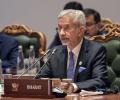
India has expressed serious concerns about the West Asia crisis and its potential impact on energy supplies and maritime stability, urging BRICS nations to find practical solutions to geopolitical challenges and unilateral sanctions.

US Vice President J D Vance stated that while progress was made during peace talks in Islamabad, it is now up to Iran to further the discussions and address US concerns regarding its nuclear ambitions.

External Affairs Minister S Jaishankar discussed the West Asia conflict and its impact on energy supplies with his Russian counterpart Sergey Lavrov and EU's Foreign Policy chief Kaja Kallas.

US President Donald Trump expressed confidence in America's position amid US-Iran peace talks in Islamabad, stating that Washington stands to 'win' regardless of a deal.

Top government sources in India have dismissed claims that the Indian Navy provided intelligence to the US regarding an Iranian frigate that was sunk by a US submarine.

Equipped with advanced weaponry, the HMS Anson is fitted with "Tomahawk Block IV land-attack missiles" with a range of 1,600 km and "Spearfish heavyweight torpedoes," providing formidable offensive capabilities.

Iran has reiterated that key preconditions must be met before negotiations with the United States can begin to resolve the conflict in West Asia, including a ceasefire in Lebanon and the release of blocked Iranian assets.
Iranian Deputy Foreign Minister Kazem Gharibabadi has urged India to take the lead in bringing peace to West Asia, highlighting the UAE's role in stalling BRICS consensus on the conflict. Gharibabadi also discussed a new framework with Oman for merchant vessels passing through the Strait of Hormuz.

Following a US agreement to a ceasefire, Iran claims victory and outlines conditions for a lasting peace deal, including control over the Strait of Hormuz and the removal of sanctions.

A Pakistani delegation, led by Army Chief Field Marshal Asim Munir, has arrived in Tehran to mediate the ongoing conflict between the US and Iran, following initial talks in Islamabad.

Pakistan's Foreign Minister Ishaq Dar met with his counterparts from Egypt and Turkiye in Islamabad ahead of a quadrilateral summit, including Saudi Arabia, to discuss the ongoing conflict in West Asia and explore avenues for peace.

Iran has announced the Strait of Hormuz is open to commercial vessels, coinciding with a ceasefire between Lebanon and Israel.

The ceasefire is still technically holding, to the extent that no overt hostilities have been reported yet, but the rhetoric has hardened dangerously. The week ahead will also clarify whether the Islamabad failure was a negotiating tactic or whether Washington has genuinely locked itself into a position from which the only exits are climb-down, escalation, or the slow bleed of a new status quo that nobody chose and nobody controls. Prem Panicker continues his must read blog on the Iran War.

Amidst escalating tensions in West Asia, Russian President Vladimir Putin is actively calling for de-escalation and political resolution, engaging with Iranian and US counterparts to navigate the complex conflict landscape.

High-level peace talks between the US and Iran, facilitated by Pakistan, aim to de-escalate the conflict in West Asia and potentially reshape regional stability.

India granted emergency docking to an Iranian ship, IRIS Lavan, in Kochi due to technical issues, accommodating its crew amidst regional naval activity and tensions.
